
Uncle Bob built his reputation telling you to read code. The estimate is his, in the first chapter of Clean Code, that the ratio of time spent reading versus writing is well over ten to one. This week, replying to a developer who said he needs to understand the code he answers for, he posted on X that his current strategy with his coding agents is to read none of what they produce:
I’m significantly older than you. I started coding in the late 60s. My current strategy is to not read any of the code written by my agents. That’s the only way I can take advantage of their productivity. What I do instead is to surround the agents with extreme constraints. Unit tests, gherkin tests, QA procedures, quality metrics, mutation testing, test coverage, and a plethora of others. In the end, I have very high confidence in the code they produce because they’ve had to run the gauntlet of all of my constraints and tests.
— Uncle Bob Martin (@unclebobmartin) July 23, 2026
I agree with practically every word. I’ve been operating this philosophy for over a year in my guideline for developing with agents, in a domain where a calculation error becomes a liability. The tweet condenses into one paragraph the most important inversion in agent-driven development. It’s also the easiest one to copy wrong.
What he’s actually saying
Read in isolation, the first half sounds like negligence. But the sentence carrying the weight comes in the second half: surround the agents with extreme constraints. He took verification away from the eye and changed its address. Confidence now lives in what the code survived, and that’s what a gauntlet is: the two rows you run between while everyone gets a swing at you. You only trust whoever crossed the whole line.
It’s the same design the auto industry uses to approve a car: no regulator reads the chassis CAD, the lab launches the car into a barrier at 64 km/h with instrumented dummies and the rating comes out of the sensors. Nobody calls a crash test negligence. They call it engineering.
And notice there’s no contradiction with the rest of his work. The three rules of TDD he’s been preaching for over twenty years already forbade writing a line of production code without a failing test first. Gherkin on his list is no accident either: an executable scenario is a spec with veto power, the role numbered acceptance criteria play in my guideline. The tweet takes TDD to its logical conclusion, by the hand of the man who turned it into a discipline: the doctrine is the same, and what changed is who types.
Reading every line doesn’t scale, and pretending to is worse
The classic code-inspection literature, the SmartBear study with the Cisco team, recommends reviewing at most 200 to 400 lines per session, because beyond that defect-detection rates fall off a cliff. A productive agent generates that volume before your first coffee. If your quality guarantee is a human reading line by line, the team’s merge throughput is the team’s reading throughput, and Lucas F. Costa already named that ceiling: any flow that depends on a human to catch the machine’s errors is limited by the human, not the machine. The answer he proposed in the same piece is called backpressure: every no the machine can give, it gives before a human looks.
What happens when volume saturates the reviewer is worse than a queue. Review degrades instead of stopping: it becomes scrolling, becomes LGTM on an eight-hundred-line diff. That’s worse than declared not-reading, because it produces the sensation of control without the control. And even where the reading is real, the diff limits what it can see: the regression outside the diff, the distant consumer of the field that changed, is invisible to whoever reads the change and trivial for the accumulated suite that runs in full on every PR. The reader sees the change; the net sees the system. Uncle Bob just said out loud the math the market pretends doesn’t exist: between theatrical review and an honest gauntlet, he chose the gauntlet.
The anatomy of the gauntlet
A gauntlet that works has layers, and the order matters: cheap and binary up front, expensive and semantic behind. Type check, lint and build are the entrance gate. Then come the unit tests, anchored on the spec’s acceptance criteria instead of mirroring the implementation, because a test that mirrors the implementation defends the current bug against the fix. Coverage enters as a floor per capability, contract tests hold the boundaries between services, and rules derived from an external source get golden tests with reference inputs and outputs, because a human reviewer doesn’t recalculate values against the norm, not even when reading the code.
On the tweet’s list, the item most people ignore is the one holding up the others: mutation testing. Coverage says the code ran during the tests; mutation testing says whether the tests would notice the code changing. The tool injects deliberate defects, flips a condition, removes a call, and counts how many mutants your suite kills. With agents this matters double, because agents optimize against the gate you measure: when the target is coverage, they learn to produce tests that execute everything and assert almost nothing. Mutation testing kills that class of test; without it, “I don’t read the code because I have 90% coverage” is self-deception with a dashboard. PIT in the Java world, Stryker for JavaScript and TypeScript, mutmut for Python: the tool exists, what’s missing is the habit. And when it doesn’t exist for your stack, you write it: Uncle Bob himself had Claude write him a mutation tester in Clojure to close the gaps in his own suite.
Above the deterministic layer comes the inferential one, with a golden rule: whoever reviews is never whoever wrote. A separate reviewer, isolated context, read-only by tool configuration. Anthropic documented first-hand the bias that justifies this: agents confidently praise their own mediocre work. Asking the agent to review its own diff is letting the student grade their own exam.
Uncle Bob’s whole list shares one trait: not one item lives in a prompt. All of it runs in CI and returns red without asking permission. A real constraint is enforcement, the model runs into it and stops; if your gauntlet lives in the system prompt, you have a polite request.
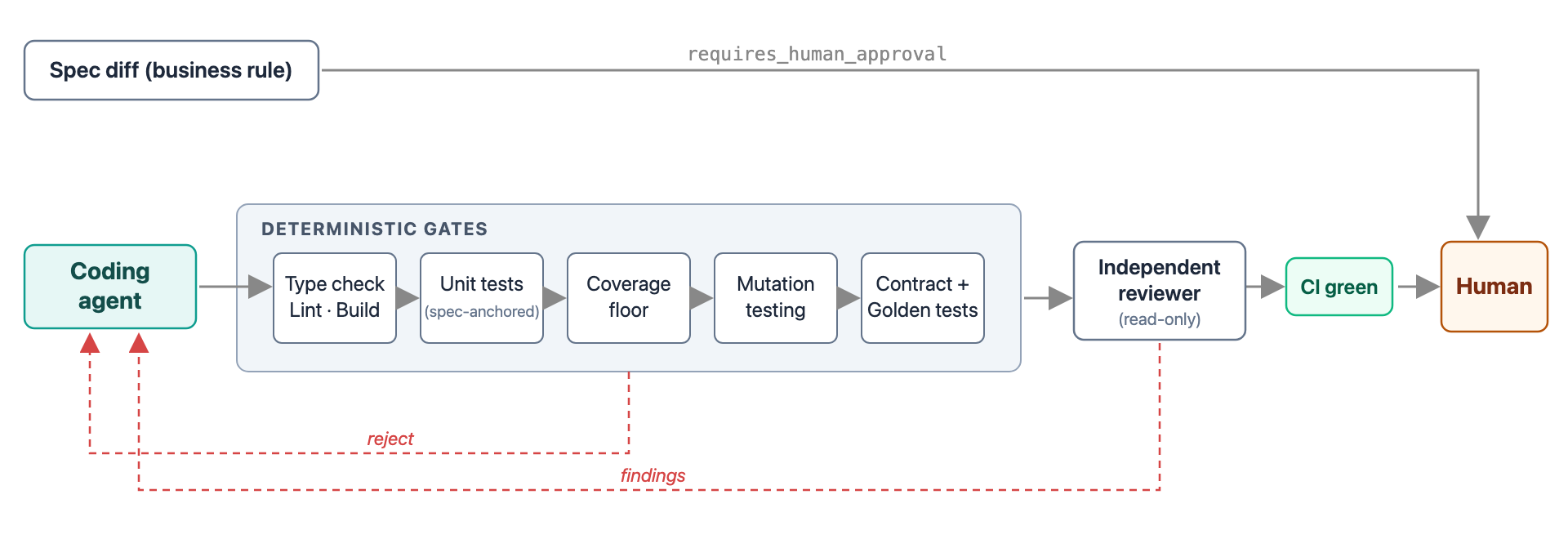
The gauntlet in layers: deterministic gates up front, independent reviewer behind them, every rejection going back to the agent before any human eye. The human receives what survived, plus the spec diffs, which never pass without a human.
What you read instead of the diff
Not reading the code doesn’t mean not reading. The reading budget changes address: it leaves the output and moves to the oracle. What gets your line-by-line attention becomes the spec and the acceptance criteria before the agent runs, the tests it wrote, because a test is a contract and reads in a fraction of the implementation’s time, the mutation score, the reviewer’s findings, and every spec diff, because business-rule changes always go through human review. In my flow that’s a requires_human_approval flag no green CI removes.
And the role changes with it. Uncle Bob didn’t leave the loop, he moved up a position: from part inspector to gauntlet designer. Every escape becomes engineering work: if a bug crossed the gauntlet, the mature question is which gate was missing, and the answer is building it. It’s backpressure applied to review, and human attention goes where it’s irreplaceable, the business rule, the boundary between capabilities, the exception the gauntlet spat out.
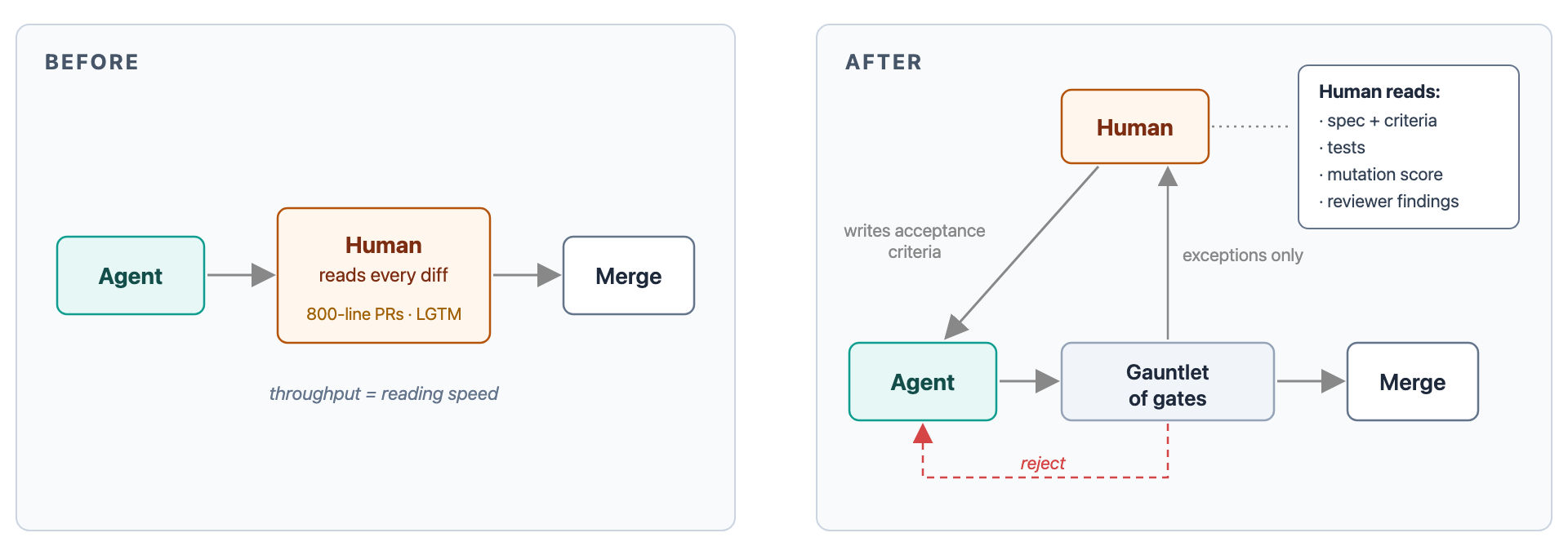
Where the reading budget goes: before, the human sits between the agent and the merge, reading diffs at volume; after, the human sits above the flow, writing criteria, reading spec, tests and scores, and receiving only the exceptions.
Where the tweet needs fine print
First caveat: the right not to read is earned, and Uncle Bob spent half a century building his. The man wrote the three rules of TDD the industry repeats and keeps publishing, this year’s Clean AI: Agentic Discipline series opens with the thesis that the greatest danger of agents is indiscipline. His gauntlet is his own work. Copying the headline without building the gauntlet is vibe coding with confidence, and I guarantee you a good share of the people repeating “I don’t even read the code” this week don’t have a single mutation test running. In my guideline this becomes an operational rule: it starts with a human approving every PR, and not-reading advances per change class, thirty consecutive clean PRs qualify that class, the rest of the system keeps waiting for its own track record. Global confidence declared on day one has another name, faith.
Second: the counterpoint has a name and the debate has history. The July tweet is round two of a conversation that started in April, when Uncle Bob had already posted that he doesn’t review agent code and measures, instead, coverage, dependency structure, cyclomatic complexity, module sizes and mutation testing. Grady Booch replied in public that he reviews all generated code, because metrics give him confidence of functionality and no confidence whatsoever that the agent hasn’t introduced vulnerabilities, dead code that erodes future understandability, missed factorizations with real performance impact. Trust but verify, he closed. The objection is serious, and the answer comes in three parts: dynamic validation, a QA agent exercising the deployed application to see what no diff analysis can; security as a deterministic gate, SAST, SCA and secret scanning on every PR; and a permanent boundary: in my system, architecture and normative calculation never enter the not-reading lane, the first because it’s a business decision in the shape of code, the second because “very high confidence” is not an argument in front of an auditor. Uncle Bob can live with high confidence; whoever answers for rules with a normative source needs an oracle, and the oracle there is a golden test with a human reading the spec diff.
Third: the gauntlet is expensive. The numbers Anthropic published from their harness experiment: the task the model solves alone for 9 dollars in 20 minutes cost about 200 dollars and 6 hours with the full harness, 124 and 4 in the second version. The gauntlet pays when the task exceeds what the model delivers reliably on its own; below that it’s ceremony. And gauntlets rot: every gate encodes an assumption about what the model can’t do alone, every model generation expires some of them, and a gate nobody re-audits becomes dead weight in the pipeline.
Fourth, the one people talk about least: reading the code was the means, understanding the logic is the end, and the gauntlet only retires the means. The system is still yours, and you need to remain able to explain why a change is safe and to draw the next boundary. Whoever lets the understanding walk out with the reading becomes a tourist in their own repository, and tourists don’t design gauntlets. My defense is a ritual: a walkthrough of every relevant feature, read for real, the map of the system kept current in my head even without reading every diff. The loop executes for you. It doesn’t decide for you.
Closing
The tweet condenses the inversion that defines agent-driven development: confidence left the reading of the artifact and moved to the process the artifact survives. The gauntlet has a known anatomy, deterministic up front, independent reviewer behind, mutation testing to keep the tests honest, enforcement instead of instruction. And the right not to read is earned per class, with evidence, with one boundary that doesn’t move: business rules, calculations with a normative source and architecture still go through human review.
The step I recommend for this week: turn on mutation testing in one critical module of one of your repositories, Stryker, PIT or mutmut depending on the stack, and compare the score with the coverage you display today; the distance between the two numbers is the size of your illusion of a net. Then write the acceptance criteria of your next feature before prompting the agent, and let the gauntlet return PRs before they reach your eye. When that starts happening often, you’ve understood the tweet: the machine is saying no on your behalf. The full gauntlet I use, skills, reviewer, hooks and spec template, is in the guideline repository.
References
- Robert C. Martin — Clean Code, chapter 1 (Prentice Hall, 2008), the 10:1 reading-to-writing ratio
- Robert C. Martin (@unclebobmartin) — the July tweet (July 23, 2026)
- Robert C. Martin — The Three Rules of TDD
- SmartBear — Best Practices for Peer Code Review, the Cisco study and the 200-400 lines per session limit
- Lucas F. Costa — Backpressure is All You Need
- Robert C. Martin (@unclebobmartin) — the Clojure mutation tester written by Claude
- Anthropic Engineering — Harness design for long-running application development
- Robert C. Martin (@unclebobmartin) — the April tweet on measuring instead of reviewing, the one Grady Booch answered with “Trust but verify”
- Clean Coders — Clean AI: Agentic Discipline
- Raphael Moura — spec-anchored-agentic-development, the full guideline with skills, reviewer, hooks and spec template
- Mutation testing tools — PIT, Stryker, mutmut